Reasons for Welfare : The Political Theory of the Welfare State (9780691221878) by Goodin Robert E
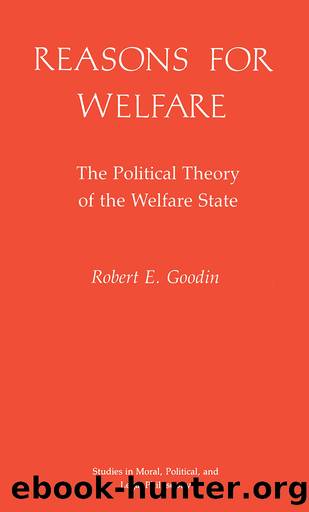
Author:Goodin, Robert E.
Language: eng
Format: epub
Publisher: Princeton Univ Pr
Published: 2020-01-24T00:00:00+00:00
VI
A regime of rights is one alternative to a regime of discretionary powers. But contrary to what is sometimes implied (especially by writers in social administration), it is not the only alternative. Here I shall first set out, in fairly formal fashion, the three distinct rule-based alternatives to a regime of discretionary powers.28 Then I shall discuss the appropriateness of each alternative remedy for the problems with discretion discussed above.
A
All alternatives to discretionary powers are, generically, strategies for using a formal set of legally-binding rules to exercise control over lower-level agents of state authority. That far, all the strategies here to be discussed are alike. They are all essentially variations on that one theme.
The distinctive feature of rights is that they constitute control from below. Specifically, rights allow citizens to exercise control over agents of authority by stipulating certain things that those agents must do to or for the rights-holders, or certain things that those agents must not do to rights-holders. Rights thus constitute one clear way of diminishing the discretionary power of state officials, by giving those subject to their authority a certain measure of legal control over them.
Broadly speaking, the alternative to rights-based controls on official discretion is a system of controls based on notions of officialsâ obligations. This strategy, in its various forms, constitutes control from above.29 A regime of official obligations provides a mechanism for higher officials to control lower ones, and (assuming no slippage) ultimately for the highestâin a democracy, the sovereign electorateâto control the lowest minion. That is the other logically possible way of limiting the discretion of intermediate state officials.
This second, obligations-based strategy admits of two basic variants. Obligations can come in the form of either duties or responsibilities. Duties stipulate particular actions which state agents must take or refrain from taking. Responsibilities, in contrast, stipulate particular outcomes which state officials must produce or avoid producing. In the former case, lower-level officials are answerable to higher-level ones for what they did or did not do. So long as they did what they were duty-bound to do, they will be deemed to have discharged their duties, no matter what happened in consequence. In the latter case, the lower-level officials are answerable to higher-level ones for what happened. So long as the right consequences have been produced (and no duties violated in the process), the officialsâ responsibilities will be deemed to have been discharged, regardless of how in particular those results were brought about (Goodin 1986c).
Download
This site does not store any files on its server. We only index and link to content provided by other sites. Please contact the content providers to delete copyright contents if any and email us, we'll remove relevant links or contents immediately.
| Elections & Political Process | Ideologies & Doctrines |
| International & World Politics | Political Science |
| Public Affairs & Policy | Specific Topics |
| United States |
The Secret History by Donna Tartt(19088)
The Social Justice Warrior Handbook by Lisa De Pasquale(12190)
Thirteen Reasons Why by Jay Asher(8910)
This Is How You Lose Her by Junot Diaz(6887)
Weapons of Math Destruction by Cathy O'Neil(6280)
Zero to One by Peter Thiel(5802)
Beartown by Fredrik Backman(5754)
The Myth of the Strong Leader by Archie Brown(5507)
The Fire Next Time by James Baldwin(5446)
How Democracies Die by Steven Levitsky & Daniel Ziblatt(5219)
Promise Me, Dad by Joe Biden(5153)
Stone's Rules by Roger Stone(5088)
A Higher Loyalty: Truth, Lies, and Leadership by James Comey(4964)
100 Deadly Skills by Clint Emerson(4925)
Rise and Kill First by Ronen Bergman(4789)
Secrecy World by Jake Bernstein(4753)
The David Icke Guide to the Global Conspiracy (and how to end it) by David Icke(4720)
The Farm by Tom Rob Smith(4512)
The Doomsday Machine by Daniel Ellsberg(4490)
